

Run smart. Finish strong.
1️⃣ Overview
Strategies are a core gameplay system in MetaHoof that allow players to define how their horse behaves during a race. Before each race, players must select a Racing Strategy, which guides how the horse distributes its effort, when to push harder, and how to react to different phases of the race.
A well-chosen strategy can be the difference between victory and fading out before the finish. Strategies also play a role during training sessions, helping players build race-ready horses by simulating real scenarios.
2️⃣ How Strategies Work
A racing strategy is composed of three key elements:
🏃♂️ Race Pacing
Defines how your horse distributes energy across the race.
| Value | Style | Description |
|---|---|---|
| 1 | High Effort | Pushes hard early. Can gain early lead but risks stamina depletion. |
| 5 | Balanced | Even energy usage across all race phases. Reliable and consistent. |
| 10 | Energy Saver | Conserves energy early to maximize power in final stages. |
Gameplay Effect:
- Directly affects stamina drain rate over time.
- Impacts how long your horse can sustain top performance without burning out.
⚡ Sprint Trigger
Determines when your horse initiates its peak performance burst during the race.
| Value | Trigger Timing | Description |
|---|---|---|
| 1 | Early Burst | Attempts a strong push early, risking stamina loss if mistimed. |
| 5 | Mid Race Push | A balanced surge during the race's middle portion. |
| 10 | Final Sprint | Reserved for the last stretch—requires stamina and precision. |
Gameplay Effect:
- Triggers a short-lived but powerful speed burst.
- Poor timing or low stamina can reduce its effectiveness or cause penalties.
🎯 Race Style
Controls how cautiously or aggressively your horse behaves under pressure.
| Value | Style | Description |
|---|---|---|
| 1 | Safe | Low-risk approach. Rarely makes mistakes but can lack edge in tight races. |
| 5 | Moderate | Balanced tactical awareness. Adapts based on position and pacing. |
| 10 | Aggressive | High-risk, high-reward. Can cause penalties like bad starts or transitions. |
Gameplay Effect:
- Aggressive styles may trigger behavior penalties under poor temperament.
- Horses with high temperament perform better under high-pressure tactics.
3️⃣ Using Strategies in Training
Training sessions allow players to:
- Experiment with strategies.
- Analyze performance based on pacing and sprint triggers.
- Build familiarity between horse and strategy type.
4️⃣ Strategy & Horse Synergy
Every horse has different traits (stamina, temperament, agility). These affect how well they respond to strategies:
- High temperament → struggles with aggressive styles.
- High stamina → ideal for early sprints or sustained pace.
Combining strategy + horse traits + trainer synergy is key for peak performance.
🎮 Strategy Creation Interface
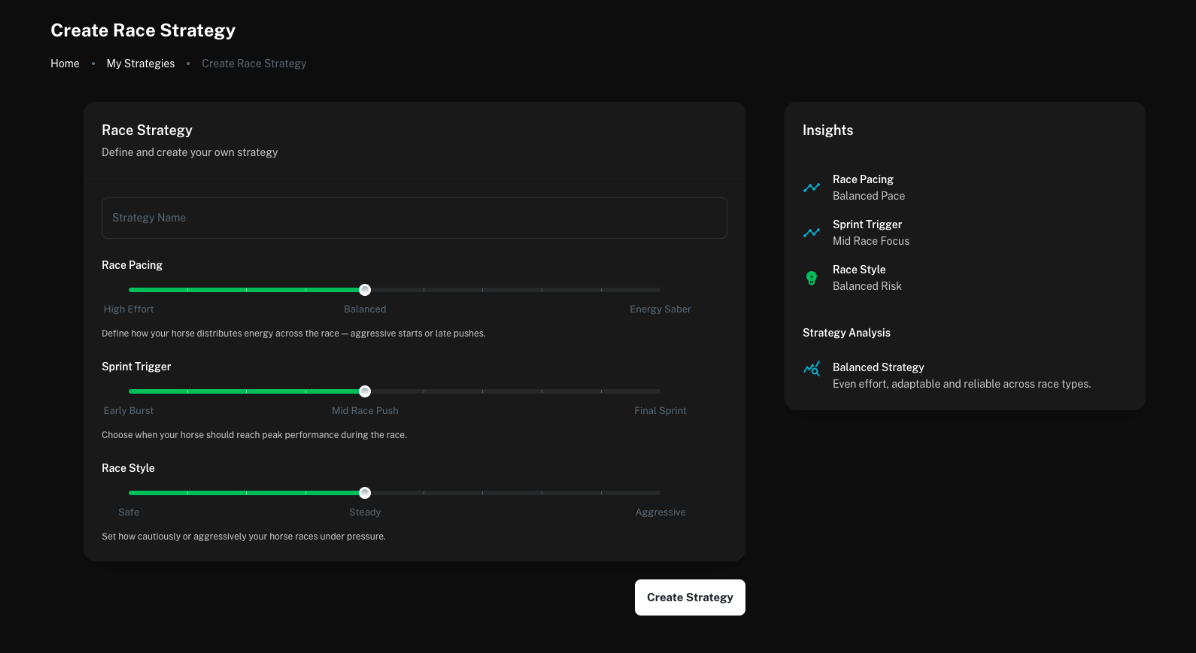
Creating a strategy in MetaHoof is intuitive and visual. The interface uses sliders to define your horse’s behavioral profile across three key attributes:
🎛️ Slider System: 1 to 10 Scale
Each attribute is adjustable on a 1–10 scale, allowing players to fine-tune their approach for different horses and race types.
| Attribute | Description | Scale Range |
|---|---|---|
| Race Pacing | Controls how your horse distributes effort over the race. | 1 = High Effort (fast start) ↔ 10 = Energy Saver |
| Sprint Trigger | Sets when the horse initiates its peak burst of speed. | 1 = Early Burst ↔ 10 = Final Sprint |
| Race Style | Defines the horse's behavioral risk under pressure. | 1 = Safe ↔ 10 = Aggressive |
🧠 Strategy Insights Panel
As you adjust the sliders, the system provides real-time insights on the right-hand panel:
- Race Pacing: Shows the selected pacing style (e.g., Balanced Pace).
- Sprint Trigger: Reflects the chosen moment to trigger sprint (e.g., Mid Race Focus).
- Race Style: Indicates how risky or safe the strategy is.
- Strategy Analysis: A smart summary of your overall setup — whether it's balanced, high-risk, or energy-conservative.
✅ Finalizing Your Strategy
Once satisfied with your configuration:
- Give your strategy a unique name.
- Click Create Strategy to save it for use in races and training sessions.
Your horse will follow this strategy whenever it's assigned—so pick wisely and always test it under different conditions.
🔗 For more: